
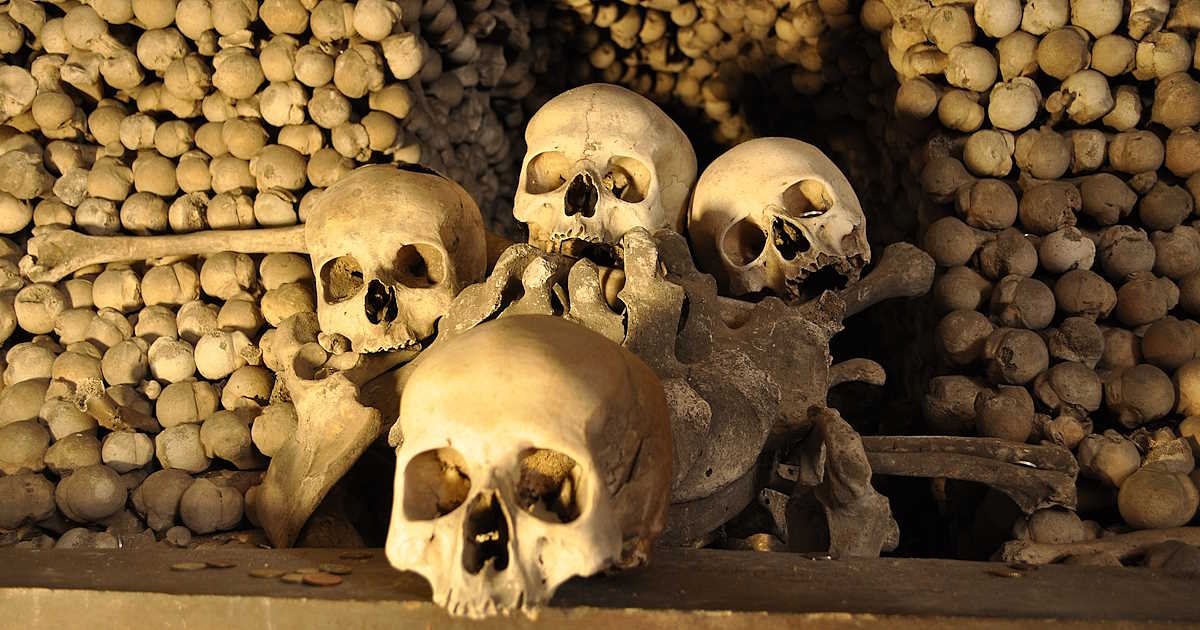
Sedlec Ossuary
Visiting information
| Opening hours | Nov–Mar: 9:00–17:00 · Apr–Oct: 9:00–18:00 |
| Admission | Adults 220 CZK · Students/seniors 170 CZK · Children 80 CZK |
| Tickets | Timed entry tickets required — buy online or at Sedlec Information Center, Zámecká 279. Entry cannot be guaranteed without reservation. |
| Photography | Not permitted inside |
| Distance from center | 2 km · 25 min walk or bus line 1/7 (stop: Sedlec, Kostnice) |
| Distance from Prague | 75 km · ~1 hour by car or direct train |
The Sedlec Ossuary (Czech: Kostnice Sedlec) is a small Roman Catholic chapel in Sedlec, a district of Kutná Hora, Czech Republic. It is decorated entirely with human bones — the remains of an estimated 40,000 to 70,000 people — making it one of the most extraordinary historical sites in Europe. The ossuary lies 2 km from Kutná Hora’s historic centre and 75 km east of Prague, and is one of the most visited attractions in the Czech Republic.
The most remarkable decorative elements include a large chandelier containing every bone in the human body and the Schwarzenberg coat of arms made of bones.
The ossuary is open to the public and ranks among the most visited tourist attractions in the Czech Republic.
History
The area where the Sedlec Ossuary stands today was inhabited as early as prehistoric times (around 2500 BC). The ossuary’s history dates back to the 13th century, when Kutná Hora was one of the largest cities in the country. A Christian cemetery belonging to the Sedlec Monastery served as the local burial ground. The cemetery was extensive, about 35 hectares (slightly smaller than Prague’s Wenceslas Square, which is 45 ha). An older church likely stood where the ossuary stands today.
The famine of 1318, the plague epidemic of 1348, the Hussite Wars, and normal mortality rates led to the accumulation of a large number of human remains.
Another event contributed to the cemetery’s popularity: according to legend, a Cistercian abbot brought back a handful of sacred soil from Golgotha in Jerusalem. The soil was scattered across the Sedlec cemetery, making it holy ground. As a result, the cemetery gained immense popularity, and people from distant parts of Europe desired to be buried there.
When the cemetery was later reduced in size, the remains had to be moved. It was decided to build a new church with an underground ossuary to store the bones in mass graves.
In the second half of the 14th century, construction began on a two-story charnel house (karner), with the ossuary and chapel for the dead below and a chapel for worship above. The remains were exhumed, cleaned, and stored in the underground chambers — not as a burial, but as a way to preserve and organize the bones.
A 16th-century legend tells of a half-blind monk who was the first to arrange the bones into artistic shapes. During his work, his eyesight was miraculously restored.
During the Hussite Wars, part of the charnel house was damaged, though less severely than the nearby monastery. The underground ossuary suffered only minor damage, while the upper part, including the vault and roof, was affected more.
From the 15th to the 17th century, the underground spaces were expanded to their current size. The arrangement of bones was refined, and structures such as bone pyramids were created.
At the beginning of the 18th century, the building was restored alongside the neighboring Church of the Assumption of Our Lady and St. John the Baptist, under the direction of the renowned architect Jan Blažej Santini-Aichel.
In the early 19th century, the estate — including the ossuary — was purchased by the Schwarzenberg family, who commissioned woodcarver František Rint to clean, bleach (using limewater), and artistically arrange the bones. His work gave the ossuary its present appearance, including the chandelier, the Schwarzenberg coat of arms, pyramids, and other decorations made of human bones. Rint’s signature, crafted from small bones, can be found to the right under the staircase.
Visitor Information
Public restrooms: Available at the Sedlec Information Center, Zámecká 279 (100 meters toward the cathedral). Paid, card payment accepted.
Parking: Usually easy to find. Parking is available near the cathedral and around the ossuary.
Getting to the Ossuary
Getting to the Sedlec Ossuary from Kutná Hora city center is simple, and there are several options:
On foot:
If you enjoy walking, the route is about 2 km and takes roughly 25–30 minutes. From the center, go along Barborská Street, cross Palackého Square, continue on Štefánikova Street, then follow Zámecká Street to Sedlec, where the ossuary is located.
By public transport: Take bus line 1 or 7 from Kutná Hora’s center to the stop Sedlec, Kostnice.
By train: From Kutná Hora Main Station, it’s just one stop to Kutná Hora–Sedlec. The ossuary is a short walk from the station. You can also arrive from the other side via Kutná Hora Město station.
By car: The drive from Kutná Hora’s center to Sedlec takes only a few minutes. Follow the signs for Sedlec; visitor parking is available near the ossuary.
Frequently asked questions
How many bones are in the Sedlec Ossuary?
The ossuary contains the remains of an estimated 40,000 to 70,000 people. The exact number is unknown — the bones were arranged decoratively in the 19th century by František Rint, making an exact count impossible.
Can you take photos inside the Sedlec Ossuary?
No. Photography is not permitted inside the ossuary, even for a fee. You can photograph the exterior freely.
How far is the Sedlec Ossuary from Prague?
About 75 km — roughly 1 hour by car or by direct train from Prague’s Main Station to Kutná Hora. From Kutná Hora train station it is one more stop to Kutná Hora–Sedlec, then a short walk.
Is the Sedlec Ossuary worth visiting?
Yes — it is one of the most visited and most unusual historical sites in the Czech Republic, and unlike many similar sites in Europe, it is remarkably well preserved. Plan 30–45 minutes for the ossuary itself. Combine it with the adjacent Sedlec Cathedral for a full half-day visit.
What is the famous chandelier made of?
The chandelier hanging in the centre of the ossuary contains at least one of every bone in the human body. It was created by František Rint in 1870 along with the Schwarzenberg coat of arms, garlands of skulls, and four large pyramids of stacked bones in the corners.
Do I need to book tickets in advance?
Tickets are not sold at the ossuary entrance. Buy them online at the official website or at the Sedlec Information Center at Zámecká 279, about 100 metres from the ossuary. In peak summer season (July–August) booking online in advance is recommended. Tickets are timed — the time on your ticket is your entry time.
Arrive 5 minutes early, no later than 10 minutes after your slot. Time slots cannot be changed; cancellations accepted up to 3 days before your visit.
More information:

